



Position Title
Professor of Japanese and Comparative Literature
EDUCATION AND DEGREE(S)
- Ph.D., Japanese, Stanford University
- M.A., Japanese, Stanford University
- M.A., English/English Literature, University of Tokyo
- M.Phil, Medieval and Renaissance Literature, University of Cambridge
RESEARCH INTEREST(S)
- Modern and Contemporary Japanese literature
- Japanese film
- The kimono
- Women Writers and Female Representation in Literature
- Objects in literature
- Literary Adaptations
COURSE(S) TAUGHT
- JPN 103: Japanese Literature in Translation: The Modern Period
- JPN 105: Modern Japanese Literature: Hero and Antihero
- JPN 153: Love, Sexuality and the Family in Modern Japanese Literature
- COM 112 / JPN 164: Japanese Cinema
- COM 007: Literature of Fantasy and the Supernatural
- COM 159: Women in Literature
- COM 195: Senior Seminar
- COM 210: Topics and Themes in Comparative Literature
PROFILE
I work in the Departments of East Asian Languages and Cultures and Comparative Literature. I received my Ph.D. in Japanese with a minor in Comparative Literature from Stanford University. Prior to UCD, I worked at Indiana University, Bloomington, and Dickinson College.
My research is primarily on modern and contemporary Japanese literature; I also work on Japanese film as well as on the kimono. As a scholar I am particularly interested in how literature and history intersect, and I examine texts as part of a broader network of cultural discourses that produce and rework vital ideas within specific historical moments. At UC Davis, I am also an affiliated faculty with Feminist Theory and Research Designated Emphasis as well as with the Maria Manetti Shrem Institute for Sustainable Design, Fashion and Textiles.
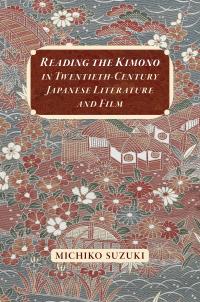
In my second book, Reading the Kimono in Twentieth-Century Japanese Literature and Film, I explore kimonos as objects to be interpreted, in order to more fully understand novels and their cinematic adaptations from the 1940s-2000s. I examine how the kimono “speaks” about characters, hidden plot points, censorship, gender politics, class conflict, wartime and postwar historical changes, and intertextual play. By excavating such “kimono language,” the book presents a history of the kimono in the modern period, offers new interpretations of significant Japanese literary and visual texts, and contributes to broader fields, such as object studies, material culture studies, and gender studies.
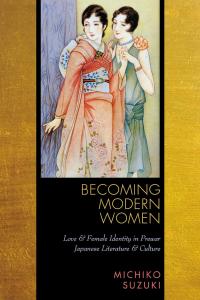
In my first book, Becoming Modern Women: Love and Female Identity in Prewar Japanese Literature and Culture, I examined fiction by women writers in conjunction with a range of non-fiction writing about love, such as love treatises and early feminist texts. Focusing on same-sex love, love marriage and maternal love—terms newly created in Japan during the early twentieth century—this book explores how modern female identity was imagined and constructed during the 1910s-30s.
I have new and ongoing projects on kimono, Japanese cinema, and Japanese women’s literature (see Current Projects below).
SELECTED PUBLICATIONS
BOOKS
Reading the Kimono in Twentieth-Century Japanese Literature and Film (University of Hawai'i Press, 2023)
Becoming Modern Women: Love and Female Identity in Prewar Japanese Literature and Culture (Stanford University Press, 2010)
EDITED VOLUME(S)
U.S.-Japan Women's Journal, Number 45, 2013. Special Issue: Women's Voices, Bodies and the Nation in 1930s-40s Wartime Literature.
ARTICLES AND BOOK CHAPTERS (SELECTED)
"Rewriting the Canon: Nakajima Kyōko's FUTON as Contemporary Japanese Feminist Literature." U.S.-Japan Women's Journal, Number 67, 2025: 29-56.
“Writing Women and Sexuality: Tamura Toshiko and Sata Ineko.” The Handbook of Modern and Contemporary Japanese Women Writers. Ed. Rebecca Copeland, 97-112. Tokyo: Japan Documents, 2022.
“The Science of Sexual Difference: Ogura Seizaburō, Hiratsuka Raichō and the Intersection of Sexology and Feminism in Early Twentieth-Century Japan.” Towards a Global History of Sexual Science. Ed. Veronika Fuechtner, Douglas E. Haynes, and Ryan M. Jones, 258-78. Oakland: University of California Press, 2018.
“Speaking Violence in a Repatriation Novel: Miyao Tomiko’s Shuka.” Proceedings of the Association for Japanese Literary Studies, Volume 19 (2018): 262-70.
“Reading and Writing Material: Kōda Aya’s Kimono and its Afterlife.” Journal of Asian Studies, Volume 76, Number 2, May 2017: 333-61.
“The Translation of Edward Carpenter's The Intermediate Sex in Early Twentieth-Century Japan.” Sexology and Translation: Cultural and Scientific Encounters Across the Modern World. Ed. Heike Bauer, 197-215. Philadelphia: Temple University Press, 2015.
“Fat, Disease and Health: Female Body and Nation in Okamoto Kanoko’s ‘Nikutai no shinkyoku.’” U.S.-Japan Women's Journal, Number 45, 2013: 33-49.
“The Husband’s Chastity: Progress, Equality and Difference in 1930s Japan.” Signs: Journal of Women in Culture and Society, Volume 38, Number 2, Winter 2013: 327-52.
“Shinju fujin, Newspapers and Celebrity in Taishō Japan.” Japan Review, Number 24, 2012: 105-25.
“Writing Same-Sex Love: Sexology and Literary Representation in Yoshiya Nobuko’s Early Fiction.” The Journal of Asian Studies, Volume 65, Number 3, August 2006: 575-99.
“Consumption and Leisure: An Intratextual Reading of Hisao Jūran’s Kyarako san.” Proceedings of the Association for Japanese Literary Studies, Volume 7, 2006: 78-84.
“Progress and Love Marriage: Rereading Tanizaki Jun'ichiro's Chijin no ai.” The Journal of Japanese Studies, Volume 31, Number 2, Summer 2005: 357-84.
“Becoming a Virgin: Female Growth and Sexuality in Yoshiya Nobuko's Yaneura no nishojo.” Across Time and Genre: Reading and Writing Japanese Women's Texts. Ed. Janice Brown and Sonja Arntzen. Edmonton: University of Alberta, 2002: 52-56.
“Kindaiteki shutai tankyū: Josei jiko keisei shōsetsu to shite no Yaneura no nishojo[Searching for the Modern Subject: Two Virgins in the Attic as Female Bildungsroman]." Kotaba to sōzōryoku (Words and Imagination). Ed. Kaneko Yūji and Ōnishi Naoki. Tokyo: Kaibunsha, 2001: 198-214.
TRANSLATION
“The Unordered World.” Translation of Okamoto Kanoko’s “Konton Mibun.” Manoa: A Pacific Journal of International Writing, Volume 8, Summer 1996: 158-71.
CURRENT PROJECTS
I am working on several new projects: one concerns issues of adaptation in fiction by contemporary Japanese women writers; the other is on Japanese film and representations of the family. I also continue to work on kimonos, especially as they appear in 20th- and 21st-century fiction and film.
HONORS AND AWARDS
- UC Davis L&S Revitalization Research Grant (2023)
- Association for Asian Studies Northeast Asia Council Japan Studies Grant (2022, 2011, 2007)
- Japan Foundation Japanese Studies Research (Long-Term) Fellowship (2019-20)
- UC Davis Humanities Institute Faculty Research Fellowship (2017-18)
- UC Davis Humanities Institute Summer Faculty Fellowship (2017)
- Indiana University Institute for Advanced Study Individual Research Award (2015)
- Indiana University Office of the Vice President for International Affairs Short-term Faculty Exchange Program (2015)
- Indiana University College Arts and Humanities Institute Travel Grant (2014, 2011, 2009)
- Florence Howe Award in foreign languages and literatures for feminist scholarship, sponsored by the Women’s Caucus for the Modern Languages (MLA organization) (2013)
- Indiana University New Frontiers in the Arts and Humanities Exploratory Travel Fellowship (2012)
- "Becoming Modern Women" designated 2010 Choice Outstanding Academic Title (2011)
- Indiana University-Bloomington Summer Faculty Fellowship (2009)
- Indiana University Trustees’ Teaching Award (2008)